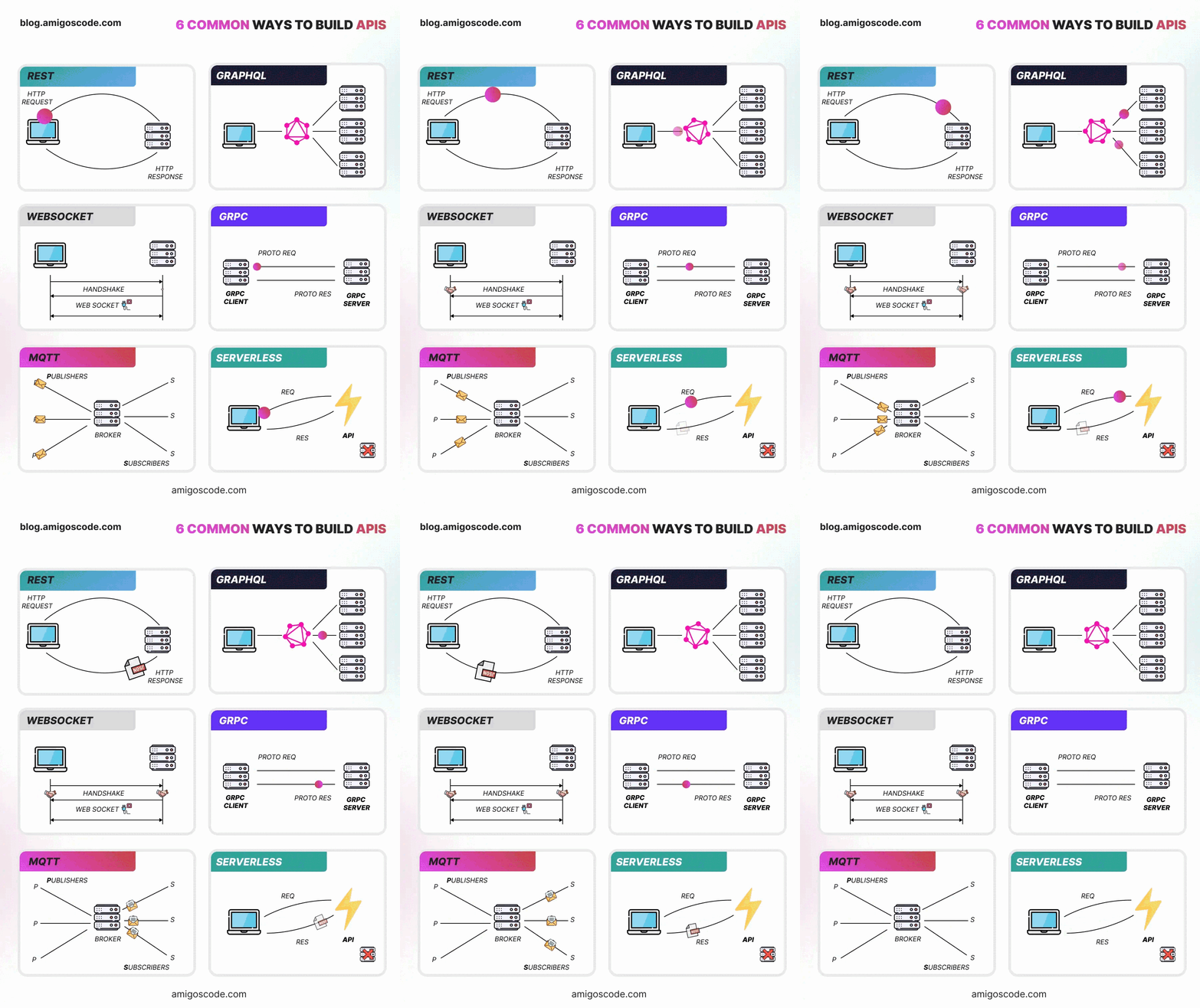
6 COMMON WAYS TO BUILD APIS
There are 6 common ways to build APIS
6 COMMON WAYS TO BUILD APIS
REST
What it is: Representational State Transfer; a stateless, resource-based approach using HTTP.
How it works: A client (often a browser or app) sends HTTP requests to a server; the server responds with resources (usually in JSON or XML).
Key details from the diagram:
Client and server exchange HTTP requests and responses.
Emphasizes the request/response model over a single connection.
GraphQL
What it is: A query language and runtime for APIs that lets clients request exactly the data they need.
How it works: A client talks to a GraphQL server (often via HTTP) which queries a graph of services/databases; the server resolves the query and returns precisely the requested data.
Key details from the diagram:
Client communicates with a central GraphQL node (often a gateway) that routes to multiple backend services or databases (depicted as a cluster of servers).
Flexible data retrieval in a single request, reducing over-fetching.
WebSocket
What it is: A protocol that provides a persistent, full-duplex connection between client and server, enabling real-time communication.
How it works: After an initial handshake over HTTP, a single long-lived connection is kept open, allowing both sides to send messages anytime.
Key details from the diagram:
Shows a client establishing a web socket connection to the server, then messages flow back and forth over the same connection.
gRPC
What it is: A high-performance RPC framework built on HTTP/2 with protocol buffers (protobuf) for serialization.
How it works: A gRPC client makes a “proto req” to a gRPC server, which returns a “proto res.” Multiple servers can be involved behind a gRPC server.
Key details from the diagram:
Client -> Proto Req -> Proto Res -> GRPC Server, with a chain-like flow to multiple nodes.
MQTT
What it is: A lightweight publish/subscribe messaging protocol designed for low-bandwidth, high-latency or unreliable networks (IoT).
How it works: There are publishers (devices producing messages), subscribers (clients consuming messages), and a broker that routes messages based on topics.
Key details from the diagram:
Shows a broker in the center connected to publishers and subscribers via topics.
Serverless
What it is: An execution model where you run code in response to events without managing servers (functions-as-a-service).
How it works: A client makes a request (REQ); the system triggers a serverless function (API) that processes the request and returns a response (RES).
Key details from the diagram:
Shows a client calling an API, which is implemented via serverless functions. The API is managed by a platform (no server you manage directly).
✅ Get Free Daily Updates on the Latest AI News -> https://debugtech.eu/blogs.php
#API #AI #softwaredeveloper #learning
------------------------------------------------------------------------------------------------------------------------------------------------------------------------------------------------------------------------------------------------
Debug Tech - a leading software development company committed to providing innovative solutions to businesses of all sizes. We specialize in web application development, mobile application development, database design, windows application development, logo designing, and SEO services. Our team of expert developers is dedicated to delivering customized software solutions that are tailored to meet the unique needs of our clients.
At Debug Tech, we pride ourselves on our ability to deliver top-quality software solutions that are both efficient and effective. Our team of developers has years of experience working with a range of programming languages and technologies. We are passionate about using our technical expertise to solve complex problems and help businesses achieve their goals.
Website: https://debugtech.eu/
linkedin: https://www.linkedin.com/company/debugtecheu/
Instagram: https://www.instagram.com/debugtech
Facebook: https://www.facebook.com/debugtecheu
Youtube: https://www.youtube.com/@debugtecheu